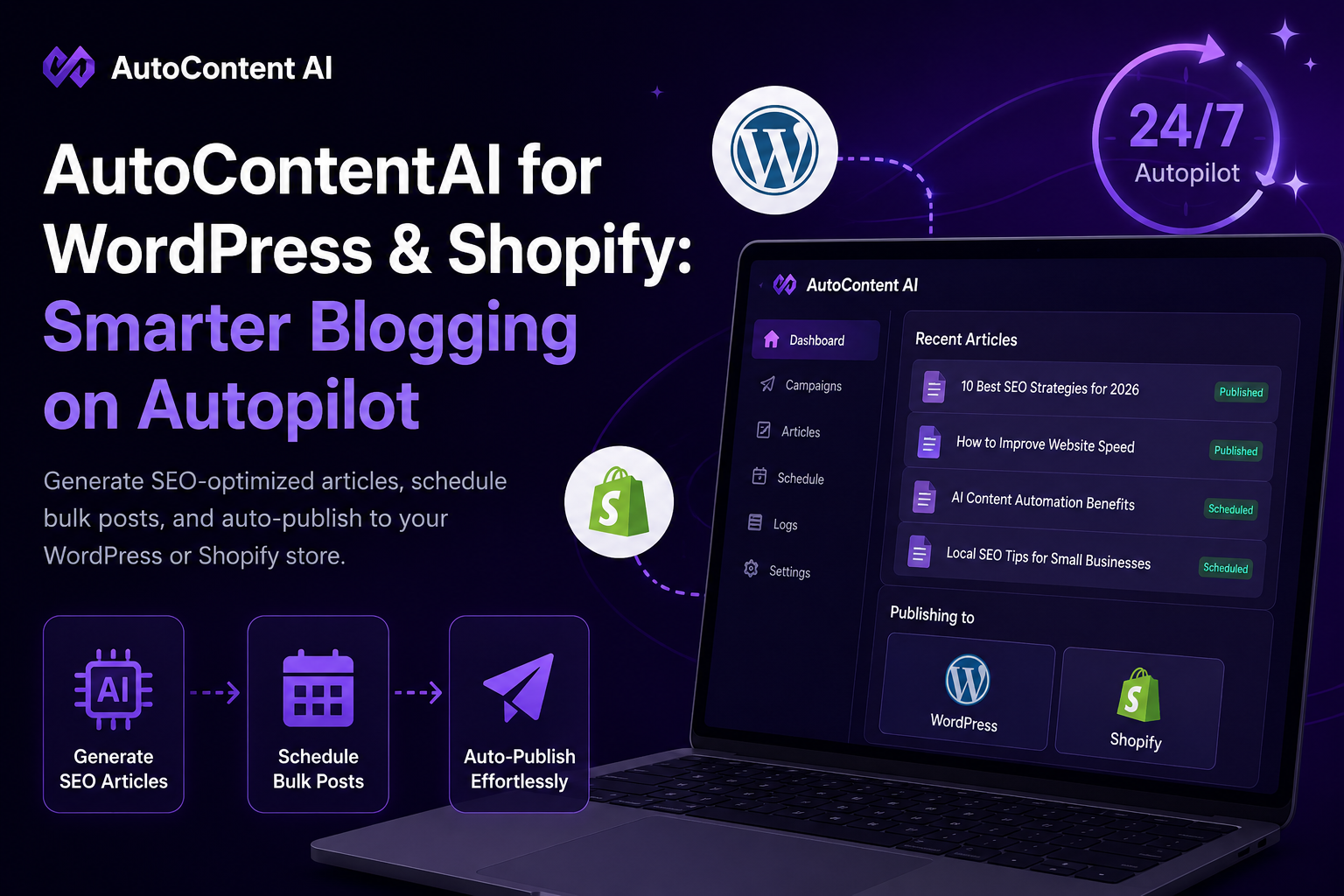
AutoContentAI helps WordPress and Shopify users automate SEO blog writing by generating optimized articles, scheduling bulk posts, and publishing blogs automatically. It helps businesses save time, publish consistently, improve organic visibility, and turn blogging into a smarter autopilot content system.
Blogging is one of the most effective ways to attract organic traffic, educate customers, build trust, and support long-term business growth. But creating blog content manually takes time. You need keywords, topics, writing, formatting, SEO optimization, scheduling, and publishing. For busy business owners, agencies, bloggers, and eCommerce teams, this process can become difficult to manage consistently.
That is where AutoContentAI helps. It gives WordPress and Shopify users a faster way to generate SEO-friendly articles, schedule content in bulk, and keep blogs active with less manual effort.
Table of Contents
- What is AutoContentAI?
- Why blogging matters for WordPress and Shopify
- The problem with manual blogging
- AutoContentAI for WordPress blog automation
- AutoContentAI for Shopify blog automation
- How AutoContentAI puts blogging on autopilot
- SEO and AEO benefits of AutoContentAI
- AutoContentAI features and benefits
- Who should use AutoContentAI?
- Best practices for smarter blogging on autopilot
- FAQs about AutoContentAI for WordPress and Shopify
- Final thoughts
What is AutoContentAI?
AutoContentAI is an AI content automation tool that helps users generate SEO-optimized articles, schedule bulk posts, and auto-publish blog content to WordPress or Shopify.
It is designed for businesses, bloggers, SEO agencies, digital marketers, and online store owners who want to publish content consistently without spending hours writing, formatting, and uploading every post manually.
With AutoContentAI, users can automate important parts of the blogging workflow, including AI article generation, SEO content structure, bulk scheduling, WordPress publishing, Shopify publishing, GEO-targeted content, activity tracking, and campaign management.
Why Blogging Matters for WordPress and Shopify
Whether you run a WordPress website or a Shopify store, blogging can help your business attract the right audience through search engines. A blog gives your website more opportunities to rank for keywords, answer customer questions, and build topical authority.
For WordPress websites, blog content can support service pages, improve search visibility, educate visitors, and help businesses build trust with potential customers.
For Shopify stores, blog content can support product discovery, buying decisions, product education, and eCommerce SEO. Instead of relying only on product pages, store owners can publish buying guides, product comparisons, how-to articles, and seasonal content that attracts shoppers earlier in the buying journey.
Consistent blogging helps both WordPress and Shopify websites stay active, visible, and useful for search engines and real users.
The Problem with Manual Blogging
Manual blogging can be time-consuming, especially when you need to publish content regularly. A single SEO blog post often requires topic research, keyword planning, article writing, SEO optimization, meta description writing, formatting, image selection, internal linking, scheduling, and publishing.
For one post, this may feel manageable. But when a business needs multiple posts every week or month, manual blogging can become slow, expensive, and inconsistent.
Common challenges of manual blogging include:
- Slow content production
- Inconsistent publishing schedules
- Missed SEO opportunities
- High content creation costs
- Difficulty targeting multiple keywords
- Too much time spent formatting and uploading posts
- Limited ability to scale content for multiple websites or stores
AutoContentAI helps solve these problems by turning blog writing and publishing into an automated workflow.
AutoContentAI for WordPress Blog Automation
AutoContentAI for WordPress helps website owners, bloggers, and agencies generate SEO-ready articles and publish them automatically to WordPress.
WordPress is widely used for business websites, blogs, service websites, affiliate sites, agency websites, and local SEO campaigns. But keeping a WordPress blog active requires consistent content creation.
AutoContentAI helps WordPress users by:
- Generating SEO-optimized blog posts
- Creating keyword-focused articles
- Supporting bulk blog generation
- Scheduling posts in advance
- Publishing blogs directly to WordPress
- Reducing manual formatting and uploading
- Helping agencies manage multiple WordPress content campaigns
For WordPress website owners, this means less time spent on repetitive content tasks and more time available for strategy, business growth, sales, and customer service.
AutoContentAI for Shopify Blog Automation
AutoContentAI for Shopify helps eCommerce store owners create and publish SEO-friendly blog content that supports product discovery and organic traffic growth.
Many Shopify stores focus mainly on product pages, but blog content can help attract customers before they are ready to buy. Shoppers often search for product advice, comparisons, guides, tips, and solutions before making a purchase.
AutoContentAI can help Shopify stores create content such as:
- Buying guides
- Product comparison articles
- Product care tips
- Seasonal shopping guides
- How-to articles
- Customer education blogs
- Niche-specific content
- Problem-solving product articles
By publishing helpful blog content consistently, Shopify stores can attract more organic visitors, educate shoppers, and support long-term eCommerce SEO growth.
How AutoContentAI Puts Blogging on Autopilot
1. AI Article Generation
AutoContentAI helps generate complete blog articles based on selected topics, keywords, and campaign goals. Instead of starting from a blank page, users can create structured blog content faster with AI.
2. SEO-Optimized Content Structure
AutoContentAI helps create content with clear headings, readable formatting, keyword-focused sections, and search-friendly structure. This makes the content easier for readers, search engines, and answer engines to understand.
3. Bulk Blog Generation
Users can generate multiple SEO-ready articles in one workflow. This is useful for content calendars, agency campaigns, eCommerce blogs, local SEO strategies, and websites that need consistent publishing.
4. Scheduled Publishing
AutoContentAI allows users to schedule blog posts in advance. This helps keep the blog active without manually publishing every article one by one.
5. WordPress and Shopify Auto-Publishing
AutoContentAI supports auto-publishing to WordPress and Shopify, helping users move from article generation to live publishing with less manual effort.
6. GEO-Targeted Content
AutoContentAI supports GEO-targeted content, allowing businesses to create location-focused articles for cities, regions, or countries. This is useful for local SEO campaigns and multi-location businesses.
7. Multiple AI Model Options
AutoContentAI gives users flexibility by supporting multiple AI models. This helps businesses choose the right model based on content quality, speed, cost, and campaign needs.
8. Detailed Activity Logs
AutoContentAI provides activity logs so users can track article generation, publishing actions, campaign activity, and automation history.
9. JSON Import and Export
AutoContentAI supports JSON import and export, helping agencies and teams back up campaign settings, move configurations, and manage multiple websites more efficiently.
SEO and AEO Benefits of AutoContentAI
AutoContentAI can support both SEO and AEO when content is helpful, structured, accurate, and created for real users.
SEO helps your blog rank in search engines. AEO, also known as answer engine optimization, helps AI search tools and answer engines understand, extract, and reference your content more easily.
AutoContentAI supports SEO and AEO by helping users create content with direct answers, keyword-focused sections, clear headings, FAQs, structured formatting, and consistent publishing.
| Optimization Element | SEO Benefit | AEO Benefit |
|---|---|---|
| Direct answer in the introduction | Improves topic clarity | Helps answer engines extract the main answer quickly |
| Keyword-focused headings | Supports search relevance | Makes sections easier to understand |
| FAQ section | Targets question-based searches | Provides answer-ready content |
| Internal and external links | Improves navigation and topical context | Helps AI systems understand relationships between topics |
| Structured tables | Improves readability | Makes comparisons easier to extract |
| Consistent publishing | Supports long-term SEO growth | Keeps content fresh and discoverable |
AutoContentAI Features and Benefits
| AutoContentAI Feature | What It Does | Business Benefit |
|---|---|---|
| AI article generation | Generates complete blog articles using AI | Saves writing time and speeds up content creation |
| SEO content structure | Creates content with headings, keywords, and readable sections | Improves search readiness and readability |
| Bulk content generation | Creates multiple articles in one workflow | Helps build content calendars quickly |
| Scheduled publishing | Schedules posts for automatic publishing | Improves consistency and reduces missed posts |
| WordPress publishing | Publishes blogs directly to WordPress | Reduces manual uploading and formatting |
| Shopify publishing | Publishes blogs directly to Shopify | Supports eCommerce content marketing |
| GEO-targeted content | Creates location-based articles | Supports local SEO campaigns |
| Activity logs | Tracks generation and publishing actions | Improves workflow transparency |
| JSON import and export | Backs up and transfers campaign settings | Helps agencies manage multiple campaigns |
Who Should Use AutoContentAI?
AutoContentAI is useful for anyone who wants to publish SEO content consistently with less manual effort.
It is especially helpful for:
- WordPress website owners
- Shopify store owners
- SEO agencies
- Digital marketing agencies
- Bloggers
- Business owners
- eCommerce brands
- Affiliate marketers
- Local businesses
- Content managers
- Freelancers
- Startup teams
If your business needs regular content, stronger SEO visibility, or a faster blogging workflow, AutoContentAI can help simplify the process.
Best Practices for Smarter Blogging on Autopilot
Choose the Right Keywords
Start with keywords your target audience is already searching for. Focus on terms related to your products, services, customer questions, and industry topics.
Match Search Intent
Every blog should match the reason behind the search. If users want a guide, provide a guide. If users want a comparison, compare clearly. If users want a solution, explain the solution directly.
Use Clear Headings
Use H2 and H3 headings to organize your content. Clear headings improve readability and help search engines understand the page structure.
Add Internal and External Links
Internal links help users and search engines discover related content. External links to trusted platforms can also improve context and credibility.
For example, you can link to AutoContentAI for AI content automation, WordPress for website publishing, and Shopify for eCommerce blog publishing.
Use FAQs for AEO
FAQs answer common questions directly and make your content easier for answer engines to understand.
Review Important Content
AI can speed up writing, but important articles should still be reviewed for accuracy, brand voice, and helpfulness before publishing.
Publish Consistently
Consistent publishing helps build topical authority and keeps your website active. AutoContentAI supports this by allowing users to schedule and publish content automatically.
FAQs About AutoContentAI for WordPress and Shopify
What is AutoContentAI?
AutoContentAI is an AI content automation tool that helps generate SEO-optimized articles, schedule bulk posts, and auto-publish blogs to WordPress or Shopify.
How does AutoContentAI help WordPress users?
AutoContentAI helps WordPress users generate SEO-ready articles, schedule posts, and publish blogs automatically, reducing manual writing, formatting, and uploading work.
How does AutoContentAI help Shopify stores?
AutoContentAI helps Shopify stores publish SEO-friendly blog content such as buying guides, product comparisons, product tips, and customer education articles to support organic traffic growth.
Can AutoContentAI publish blogs automatically?
Yes, AutoContentAI supports scheduled publishing and auto-publishing to WordPress and Shopify.
Is AutoContentAI useful for SEO?
Yes, AutoContentAI supports SEO by helping users generate keyword-focused, structured, and consistent blog content that can improve organic visibility over time.
Can AutoContentAI help with local SEO?
Yes, AutoContentAI supports GEO-targeted content, which helps businesses create location-based articles for cities, regions, and countries.
Is AutoContentAI only for bloggers?
No, AutoContentAI is useful for bloggers, businesses, SEO agencies, WordPress website owners, Shopify store owners, affiliate marketers, and content teams.
Does AI-generated content work for SEO?
AI-generated content can support SEO when it is helpful, accurate, original, well-structured, and reviewed for quality before publishing.
Final Thoughts
Blogging is still one of the most valuable ways to grow online visibility, attract organic traffic, and build trust with customers. But manual blogging can take too much time, especially for WordPress websites and Shopify stores that need consistent content.
AutoContentAI helps WordPress and Shopify users put blogging on autopilot by generating SEO-optimized articles, scheduling bulk posts, and publishing content automatically.
For businesses, bloggers, agencies, and eCommerce brands, AutoContentAI makes blogging smarter, faster, and easier to scale.
If you want to save time, publish consistently, and grow your SEO content strategy, AutoContentAI gives you a smarter way to automate blogging for WordPress and Shopify.
Leave a Reply